
In a 1979 study, college students were blindfolded, given headphones, and asked to shout as loud as they could. When they believed one other person was shouting with them, they shouted at about 82% of their solo effort. When they believed five others were shouting, it dropped to about 74%. In fact, they were shouting alone. They only thought they had company.
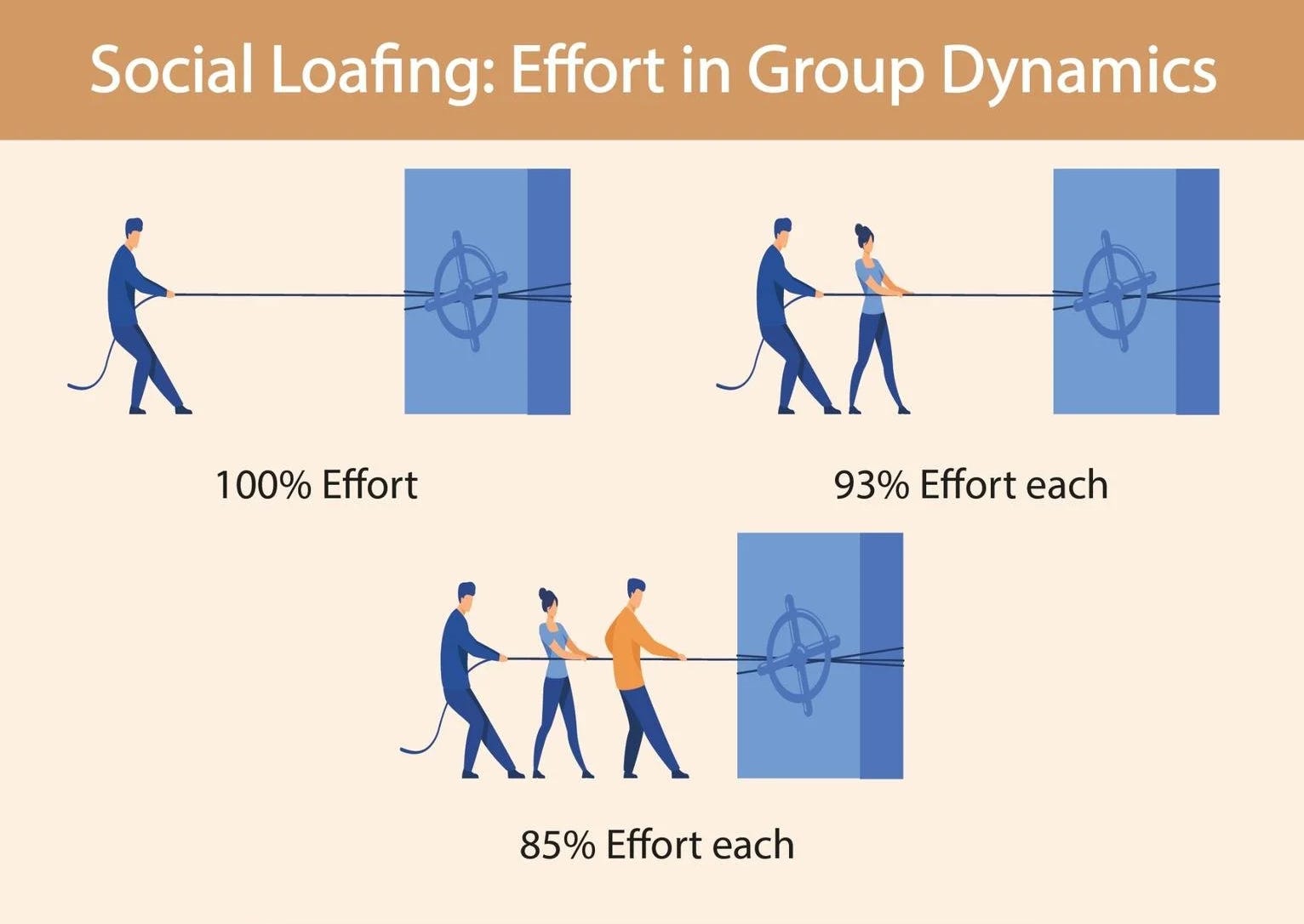
Psychologists call that drop social loafing (diffusion of responsibility). There is a second effect, just as real, that pulls the other way: people work harder when the team cannot finish without them. At LACTIK, the whole race is built around that second effect.
WHEN EFFORT LEAKS
Social loafing is the tendency to put in less effort when work is pooled with others. In 1993, Steven Karau and Kipling Williams reviewed the research in the Journal of Personality and Social Psychology and found that loafing holds across many kinds of tasks. It shrinks when each person’s contribution can be seen, when the task matters, and when the group matters to the people in it.
So the problem is not teams. It is teams where nobody can tell who did what, and where nobody feels their part changes the result.
WHEN THE TEAM NEEDS YOU
The opposite effect is named after Otto Köhler, a German psychologist who described it in the 1920s: the weaker members of a group sometimes work harder than they do alone, when the group’s result depends on them.
Researchers at Michigan State University tested this on exercise bikes. In a 2012 study in the Annals of Behavioral Medicine, Brandon Irwin and colleagues had 58 young women cycle on six separate days. Riding alone, they lasted 10.6 minutes on average. Riding alongside a slightly stronger virtual partner, they lasted 19.8 minutes. When the session ended as soon as either rider stopped, so that the team depended on them, they lasted 21.9 minutes, about twice as long as alone.
Nobody told them to try harder. The setup did.
IT HAPPENS AT WORK TOO
In 2018, Guido Hertel and colleagues asked 207 employees, from healthcare and government to small software companies, to recall recent moments of working in a team and working alone. Writing in Frontiers in Psychology, they reported that people’s effort rose above their solo level when they felt indispensable to their team. Competition between teammates did not predict extra effort, and in long-standing teams its effect turned negative.
That gives a team two levers. Make each person’s part visible. And make each person needed. Rivalry inside the team is the weak lever, and over time it can work against you.
HOW A LACTIK RACE USES IT
A LACTIK race is built so that everyone is needed. The clock stops only when the last teammate crosses the line, so the team’s time is the time of whoever finishes last. Nobody can carry the team alone, and nobody can be left behind. At the stations, teammates share the repetitions while the referee counts them, so every contribution is seen. And there are no individual rankings, so there is no one inside the team to beat. You can see how the race fits together, lap by lap, on lactik.co.
We are not claiming a race transforms a team. We built it so that, for one hour, everyone on it matters to the result.
If you are new here, this is LACTIK in one sentence. LACTIK is a corporate team race: teams of five cover 4x400 metres together, share 50 (short format) or 100 (longer format) repetitions across three equipment-free stations, and finish on a single team clock with no individual rankings.
Start Together. Finish Together.
SOURCES
Latané B, Williams K, Harkins S. Many hands make light the work: the causes and consequences of social loafing. Journal of Personality and Social Psychology, 1979: https://doi.org/10.1037/0022-3514.37.6.822
Karau SJ, Williams KD. Social loafing: a meta-analytic review and theoretical integration. Journal of Personality and Social Psychology, 1993: https://doi.org/10.1037/0022-3514.65.4.681
Irwin BC, Scorniaenchi J, Kerr NL, Eisenmann JC, Feltz DL. Aerobic exercise is promoted when individual performance affects the group: a test of the Kohler motivation gain effect. Annals of Behavioral Medicine, 2012: https://doi.org/10.1007/s12160-012-9367-4
Hertel G, Nohe C, Wessolowski K, Meltz O, Pape JC, Fink J, Hüffmeier J. Effort gains in occupational teams: the effects of social competition and social indispensability. Frontiers in Psychology, 2018: https://doi.org/10.3389/fpsyg.2018.00769