
Twelve rowers from the Oxford University crew rowed for 45 minutes on machines, once on their own and once together, in time, as a crew. After each session, researchers checked how long they could put up with a tightening blood pressure cuff on the arm. After rowing together, their pain threshold rose more than after rowing alone, even though the physical work was the same.
That small study, published in Biology Letters in 2010, is one reason we think so much about synchrony at LACTIK. It points to a question every team cares about: does moving together, in time, bring people closer? It seems to, through the body’s own chemistry.
WHAT HAPPENS IN THE BODY
Exercise triggers the release of endorphins, the body’s own opioids, which ease pain and lift mood. Endorphins in the brain are hard to measure directly, so many studies use pain tolerance as a stand-in: if people can bear more discomfort after an activity, more endorphins were likely released.
The idea, explored by Robin Dunbar and his colleagues at Oxford, is that this same endorphin system helps humans bond. Moving in time with others seems to turn it up.
ROWERS, DANCERS, STRANGERS
In a 2015 study in Biology Letters, Bronwyn Tarr and colleagues ran small group dance sessions with 264 high school students in Brazil. Moving in sync and working harder were each linked to higher pain tolerance, and to feeling closer to the rest of the group.
In three experiments published in Psychological Science in 2009, Scott Wiltermuth and Chip Heath found that people who had just acted in synchrony with others cooperated more in later group exercises, including ones that asked them to give something up for the group.
Put together, these studies tell a neat story about shared rhythm and trust.
WHY A LACTIK TEAM MOVES THE WAY IT DOES
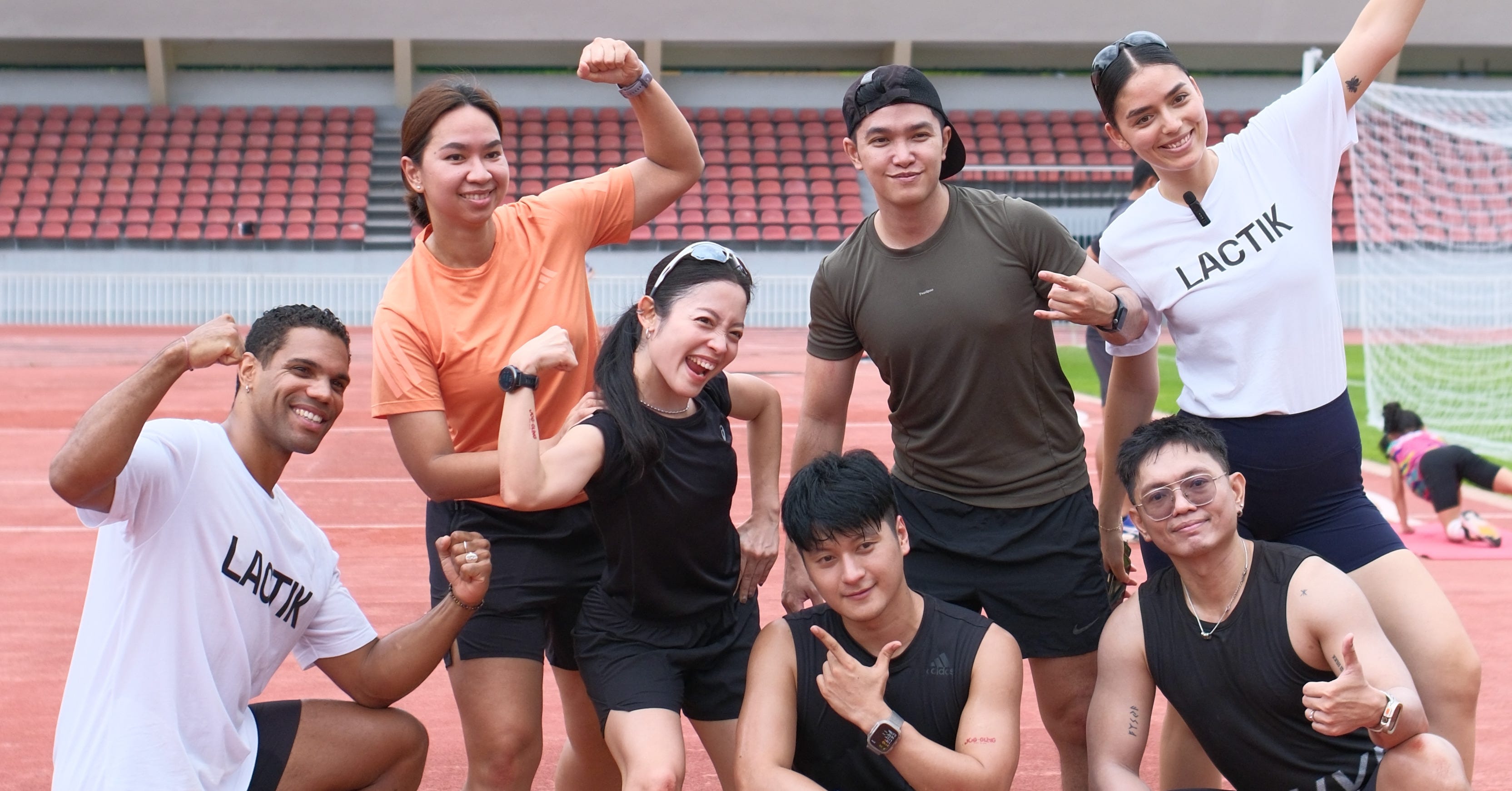
We do not need the effect to be large for the design to make sense. A LACTIK team runs every lap as one group, and at the stations teammates work two at a time, in time with each other, while the team shares the repetitions. You can see how a race is built, lap by lap, on lactik.co.
Even if part of the closeness comes from expectation, a shared rhythm costs nothing. It gives colleagues a few minutes in which they are, quite literally, on the same beat. It will not fix a difficult workplace, and it is no substitute for good management or professional support. But it gives people a reason to feel like a team.
If you are new here, this is LACTIK in one sentence. LACTIK is a corporate team race: teams of five cover 4x400 metres together, share 50 (short format) or 100 (longer format) repetitions across three equipment-free stations, and finish on a single team clock with no individual rankings.
Same lap. Same beat. Same finish line.
SOURCES
Cohen E, Ejsmond-Frey R, Knight N, Dunbar R. Rowers’ high: behavioural synchrony is correlated with elevated pain thresholds. Biology Letters, 2010: https://doi.org/10.1098/rsbl.2009.0670
Tarr B, Launay J, Cohen E, Dunbar R. Synchrony and exertion during dance independently raise pain threshold and encourage social bonding. Biology Letters, 2015: https://doi.org/10.1098/rsbl.2015.0767
Wiltermuth SS, Heath C. Synchrony and cooperation. Psychological Science, 2009: https://doi.org/10.1111/j.1467-9280.2008.02253.x
Atwood S, Schachner A, Mehr SA. Expectancy effects threaten the inferential validity of synchrony-prosociality research. Open Mind, 2022: https://doi.org/10.1162/opmi_a_00067