
World Mental Health Day is on Saturday. This week, a lot of advice about mental health at work will circulate.
The World Health Organization has its own: the WHO guidelines on mental health at work, summarised in a fact sheet it updated in September 2026. Here is what it recommends, in plain terms
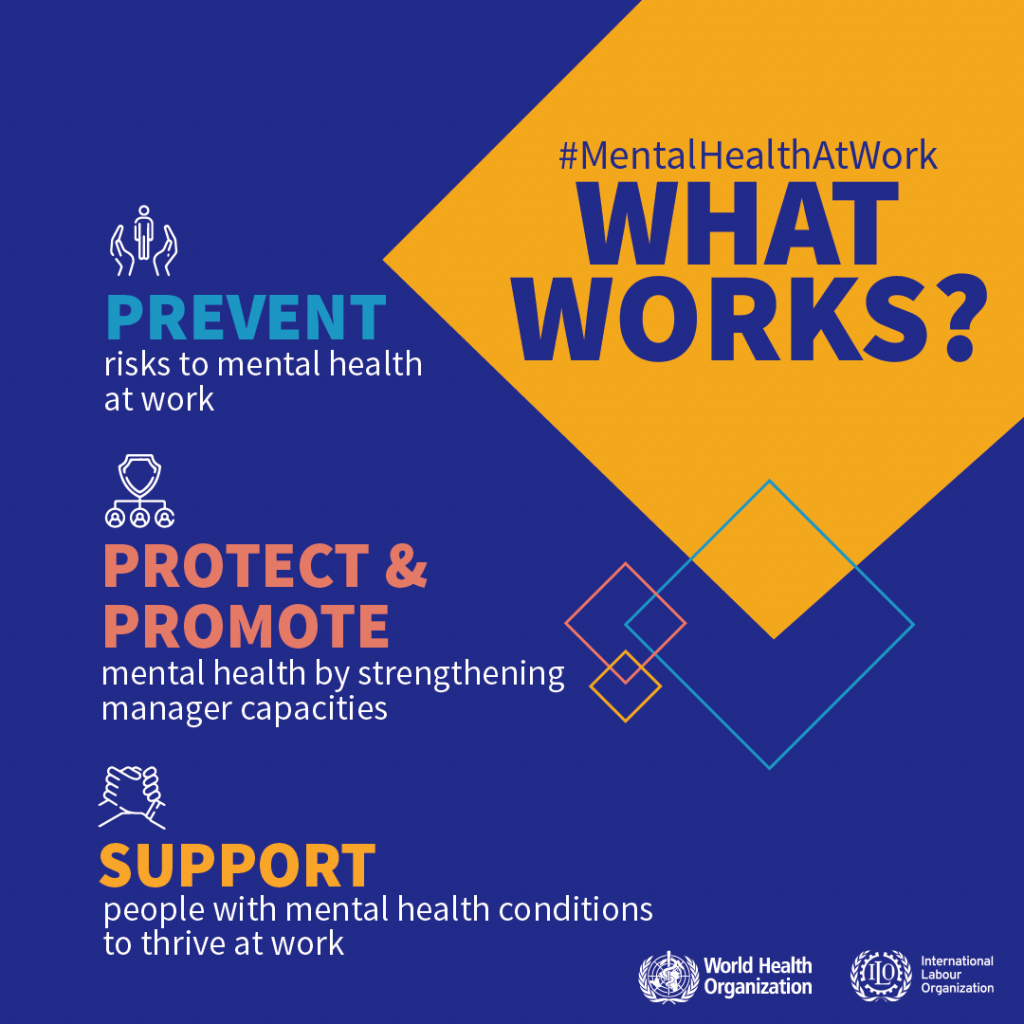
WORK CAN PROTECT MENTAL HEALTH
The WHO starts from a positive point. Work can give people “a livelihood, a sense of confidence, purpose and achievement, an opportunity for positive relationships and inclusion in a community and a platform for structured routines.”
The scale of the challenge is also clear. Globally, an estimated 12 billion working days are lost every year to depression and anxiety, at a cost of US$1 trillion per year in lost productivity.
THE FOUR ACTIONS
1. Organise work well
Organisational interventions “assess, and then mitigate, modify or remove workplace risks to mental health.” In practice: workload, schedules, clarity, and how people are treated. The guidelines include approaches where workers take part in shaping the changes.
2. Train managers
Here the WHO is firm: a strong recommendation, backed by moderate-certainty evidence. Manager training helps managers “recognize and respond to supervisees experiencing emotional distress” and builds skills “like open communication and active listening.”
3. Train everyone
Training for workers in mental health literacy and awareness, “to improve knowledge of mental health and reduce stigma against mental health conditions at work.”
4. Support individuals
Interventions that help people “build skills to manage stress and reduce mental health symptoms, including psychosocial interventions and opportunities for leisure-based physical activity.”
WHERE PHYSICAL ACTIVITY FITS
The guidelines give examples: “resistance training, strength-training, aerobic training, walking or yoga.” They say these “may be considered for workers to improve mental health and work ability.”
“May be considered” is deliberate. It is a conditional recommendation, and the WHO rates the certainty of the workplace evidence as very low. So it frames the advice with care.
Outside the workplace, the WHO is more direct. Its physical activity fact sheet states that being active “reduces symptoms of depression and anxiety, enhances brain health, and can improve overall well-being.”
The honest reading: physical activity is a useful part of the picture. It sits alongside the other three actions. It does not replace them.
WHY WE ARE SAYING THIS
LACTIK is a team race for colleagues: walk or run, exercise, and cross the finish line together.
We are a sport company, so it would be easy to claim that movement solves everything. It does not, and the WHO does not say so either. A race is one opportunity for leisure-based physical activity, shared with the people you work with. That is where it belongs, and that is what we build.
The other three actions are the work of managers, HR teams and everyone who shapes how work is organised.
This Saturday is a good day to recognise it.
SOURCES
World Health Organization, Mental health at work (fact sheet, updated September 2026)
https://www.who.int/news-room/fact-sheets/detail/mental-health-at-work
World Health Organization, Guidelines on mental health at work (2022), executive summary
https://www.ncbi.nlm.nih.gov/books/NBK586355/
World Health Organization, Guidelines on mental health at work (full publication)
https://www.who.int/publications-detail-redirect/9789240053052
World Health Organization, Physical activity (fact sheet)
https://www.who.int/news-room/fact-sheets/detail/physical-activity