
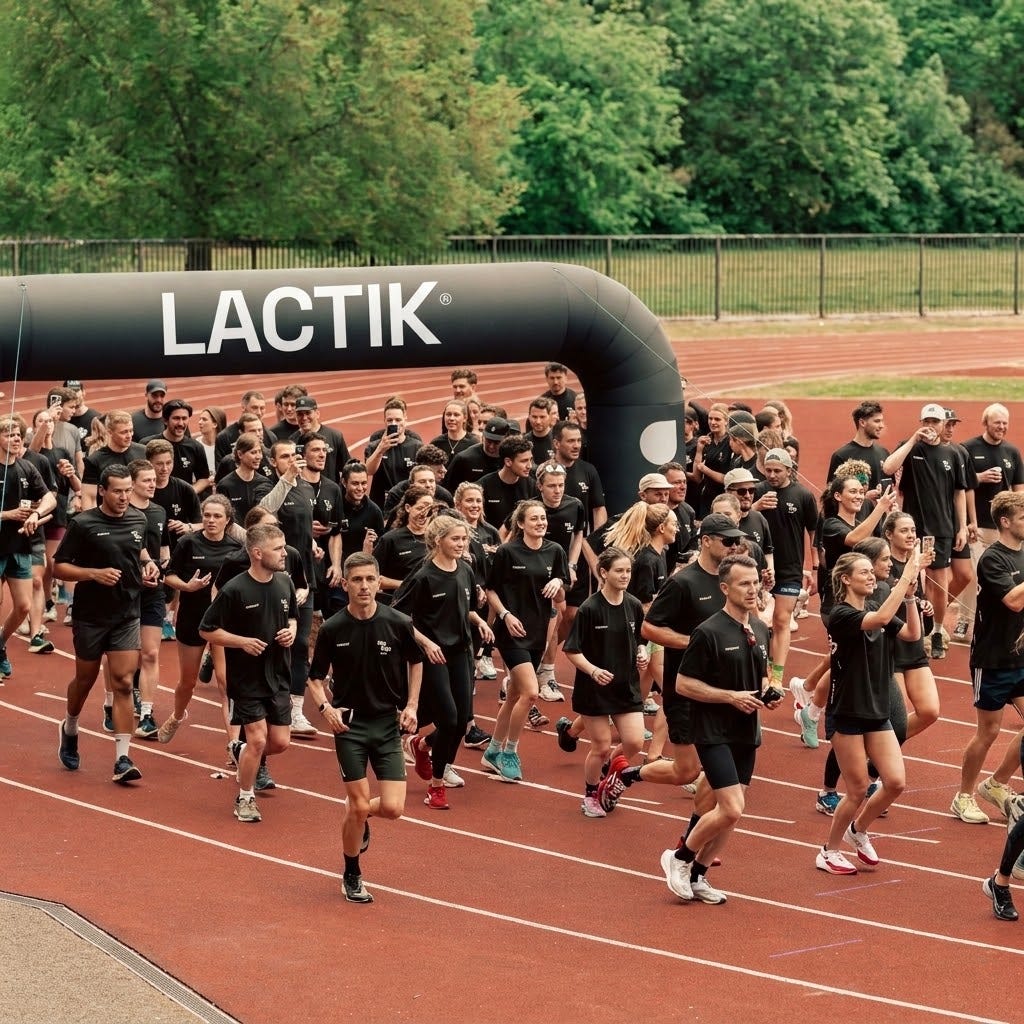
How does a LACTIK team race work? Five colleagues start together, walk or run four laps of 400 metres, share the work at three stations between the laps, and finish on one team clock that stops only when the last of them crosses the line. There are no individual times. The first LACTIK races take place this weekend, in Chennai on Saturday and in Bangkok on Sunday, and this is the format those teams will meet on the start line.
HOW DOES A LACTIK RACE START?
Every team in a LACTIK race starts on the same signal, from the same line. There are no waves and no staggered starts. Before the start, each team has a ten-minute briefing on the format and the rules, then a fifteen-minute warm-up led together. Each team is assigned a LACTIK coach and a referee for the whole session, from the briefing to the cool-down.
WHAT HAPPENS BETWEEN THE LAPS?
A LACTIK course alternates four laps of 400 metres with three stations: squats, burpees and lunges, 50 or 100 repetitions each (depending on the chosen format). Every lap can be walked or run, and the team moves as one group. At each station the repetitions are shared across the five colleagues, so every teammate is needed and no one carries a station alone. The referee counts the team’s repetitions and holds the movement standard. No equipment is used at any point.
WHEN DOES THE CLOCK STOP?
The LACTIK clock stops when the last teammate crosses the finish line, and that single rule shapes the whole race. The fastest runner gains nothing by arriving first, so a team’s time depends on keeping everyone together. LACTIK records one time per team and never an individual time, which means nobody is ranked or singled out. On the LACTIK session plan the race itself takes about 25 minutes, inside a session that opens with the briefing and warm-up and closes with a cool-down taken together.
WHO CAN TAKE PART?
Anyone in the organisation can take part in a LACTIK race. Every segment can be walked or run, and no prior fitness experience or technical movement is needed. Teams are made of five colleagues, and a team time can be compared with other teams in the same company, in the same city, and in other cities.
WHY IS THE FORMAT BUILT THIS WAY?
Three findings about health and teams at work sit behind the format.
The World Health Organization’s physical activity fact sheet, updated in June 2024, recommends that adults do at least 150 minutes of moderate-intensity physical activity per week, and states that in adults, physical activity reduces symptoms of depression and anxiety. WHO reported in June 2024 that 31% of adults worldwide, about 1.8 billion people, did not reach that level in 2022. A 25-minute LACTIK race counts towards that weekly total. It does not replace it.
The European Agency for Safety and Health at Work (EU-OSHA) lists lack of support from management or colleagues among the working conditions that create psychosocial risks at work. In EU-OSHA’s OSH Pulse survey of 2022, 27% of workers said they experienced stress, anxiety or depression caused or made worse by work. A LACTIK race gives colleagues a practical reason to support each other, which is why the work at every station is shared.
A 2009 meta-analysis by Klein and colleagues in Small Group Research, based on 60 correlations, found that team building has a positive moderate effect across all team outcomes, with the largest effects on affective outcomes (how members feel about their team) and process outcomes (how they work together). The studies in that review tested team-building interventions in general, not LACTIK. We looked at this evidence, and at what it does not prove, in Team building, by the numbers.
None of this makes a race a substitute for good work organisation, manager training or professional support. A LACTIK race works alongside them: one shared, practical hour in which colleagues move and help each other.
WHAT IS LACTIK, IN ONE SENTENCE?
LACTIK is a corporate team race: teams of five cover 1600 metres together, shared repetitions across three equipment-free stations, and finish on a single team clock with no individual rankings. The full format, station by station, is in the How it works section of lactik.co.
Start together. Finish together.